Ant Death Circle

AntOn the train to work this morning, a friend told me about a fascinating phenomenon known as the ’Ant Death Circle’ (also called the ‘Ant Death Spiral’ or ‘Ant Mill’).

What happens is that ants sometimes lose the pheromone track laid down for them to follow, and veer off course. Each ant then follows the ant in front and the group forms a continuously rotating circle. The ants then blindly follow this circular trail until they die of exhaustion.

Pretty depressing stuff huh? Poor ants.

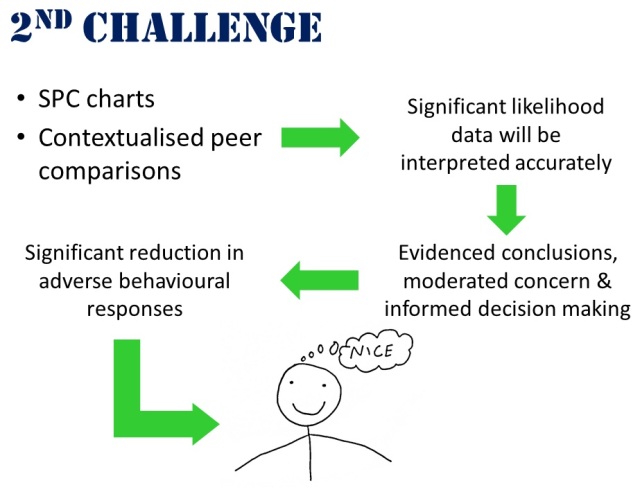
The powerful and emblematic image of the ant death circle made me immediately think of parallels in conventional performance management - the self-perpetuating downward spiral of targets, binary comparisons, internalised peer vs peer competition, and so on. How often do we unquestioningly follow the ‘ant’ in front and do what we’ve always done, for that reason alone? Because it’s the policy. Because it’s how we do things round here. Because the boss says so.

Maybe you’re an ‘ant’ trudging along within the circle, finding it difficult to break away from the norm but wanting to go and look for that pheromone trail. If so, remember that time is running out.

Act now before it’s too late.

Posted in Systems thinking | Tagged , , , , , | 1 Comment

Dial ‘F’ For Failure

111The NHS recently launched its non-emergency 111 number. Staffed by ‘a team of fully trained advisers’, the scheme’s aim is to quickly and accurately identify the most appropriate medical response to the caller’s needs.

What’s important to note is that the ‘fully trained advisors’ aren’t doctors, nurses or paramedics, and do not make clinical decisions themselves. Rather, they use a ‘clinical assessment system’ to assess caller’s needs, and are ‘supported’ by clinical advisors such as doctors, nurses or paramedics.

In other words, expertise is positioned away from the front end (where contact occurs with service users), and the operators work their way through menu-driven options, much as in the same way as when you call up your internet service provider to inform them that your connection has crashed again. This type of model builds in failure, and the 111 service is no different.

The 111 helpline has attracted a lot of media attention recently, as the following examples demonstrate:

As you can see, there have been lots of problems. Why does this failure occur? Bad people?

No.

It’s the inherently unstable system design, coupled with a management mindset that ensures all the wrong buttons are pressed when the cracks begin to show.

Putting aside the potential confusion caused when someone who needs medical help tries to figure out whether their situation is ‘less urgent than 999′, let’s look at the bigger picture and try and understand some of the systemic effects of this type of model. For this, I will use one of my drawings:

111 drawingAs you can see, the deficiencies inherent in the 111 model lead to adverse reactions within and around it. Other parts of the system, already subject to their own dysfunctional constraints (such as in A&E) bear the brunt of the badly designed front end. Failure leads to failure and this places further strain on all parts of the system. Faced with a buckling infrastructure, management does what it knows best and reverts to the counterproductive reactions listed, which serve only to intensify the problem. Meanwhile targets are still often met.

The antithesis to this type of self-perpetuating mess is simple. You’ve heard it before:

  • Adopt a whole system perspective.
  • Design the front end to handle predictable demand.
  • Ensure expertise is positioned at the point of contact with the service user.
  • Remove targets.

This will help both the patient and the system get better.

Posted in Systems thinking | Tagged , , , , , , , | 5 Comments

My Name is Bill King

‘Bilking’ (also known as ‘making off without payment’) was an offence under the Theft Act 1978. The most common forms include running off from a taxi without paying the fare, running off from a restaurant without paying for your dinner, or driving off from a petrol station without paying for your petrol. Naughty.

Anyway, now you get the picture, let me tell you about something that happened to me today. Firstly, I know you’ll be pleased to see we’re back in the familiar blog territory of pub food and drink. Secondly, I’m going to treat you to another of my drawings. Good times eh?

This afternoon I visited a pub for lunch. The layout of the place is depicted in the diagram below -

Bilking - Seating plan

As you can see, customers can choose from traditional table seating or comfy sofas with lower tables. I opted for the latter, thereby inadvertently triggering a bizarre and counterproductive company policy. You see, if customers wish to eat their food in the settee area, they must forego the privilege of being able to pay their bill at the end of the meal, and instead have to stump up the cash up front. I asked about this and the staff said it was to prevent people running off without paying, as the sofas are closer to the door!

I was too hungry to be indignant and didn’t fancy moving to a ‘normal’ table, so proceeded to purchase each round of drinks and food separately as I went along, using my card. Unfortunately for the venue, the first casualty of their seating policy was that rather than incur a single card handling charge when a bill is paid at the end, they racked up a fresh charge every time I had to pay up front for a drink. D’Oh!

Although the place was pretty empty, it took ages for my food to arrive, which gave me plenty of time to torment myself with systems thoughts about the bizarre seating rules. Here’s what struck me:

Firstly, a couple of the traditional table seats were actually closer to the door than some of the sofas – odd then that whilst the perceived risk of bilking was limited in the management’s eyes to those who would choose to sit anywhere in the settee area, others who were trusted to pay at the end by virtue of their table type could actually make a bolt for the door with relative ease.

Secondly the whole assumption about human behaviour was a pretty negative one, regardless of where you chose to sit, i.e. -

  1. If you sit in the settee area you’re planning to run off without paying.

OR

2. If you sit at a traditional table you want to run off without paying but won’t, only because you’re a bit further away from the door.

A pretty dim view of us customers all round really.

Finally, the utterly lamentable futility of management’s attempts at mitigating the perceived risk of bilking was pretty obvious (to me, anyway). Let’s face it, the whole policy seems to rely on the hope that any potential bilkers in the traditional seating area are positioned far enough away from the door so as to give bar staff sufficient reaction time to detain any opportunistic miscreant who tries to scoff and run, thus thwarting their cunning escape. The reality is that anyone could walk out at any time, regardless of where they had been sitting.

The systemic considerations and effects are many:

  • Prevailing disposition of mistrust.
  • Removal of staff discretion.
  • Irritated customers and potential loss of repeat custom.
  • Increased cost.
  • Unnecessary bureaucracy.
  • One-size-fits-all policy based on unfounded risk aversion.
  • Disproportionate reactions to relatively low-risk, low frequency events.

Recognise any of this stuff in other settings?

Posted in Systems thinking | Tagged , , , , | 2 Comments

Finding the Source

Hierarchy of birdsAs I go about my formal and informal research into the effects of target-driven performance management, I regularly have conversations with people at all levels of organisations.

One thing I’ve found is that the people at the very top of organisations tend to be intelligent, articulate individuals who genuinely care about their organisation and want it to perform well. I’ve also discovered that those who advocate targets usually do so in the honest belief that they are a necessary feature of performance management. It’s ingrained in their thinking.

Something else that I’ve become increasingly aware of is a common theme amongst the comments made by these very senior people.

Recognise any of these?

Finding the source quotes

Let’s have a look at these viewpoints in more detail, to try and encourage a different way of thinking about the ‘targets conundrum’.

Finding the source 1

My response to this is usually, “Well get rid of them then!” It’s simply about making a cost / benefit analysis to assess the risks involved. If you already know that targets are likely to cause gaming, cheating, data distortions and other dysfunctional behaviour, why retain them? This normally leads onto a discussion about what else could possibly be out there if the targets are removed. The answer? MEASURES. ‘Right measures, measured right’, remember? (See here for more – Getting measures confused with targets is such a common – and fatal – mistake. They are totally different things!)

Finding the source 2

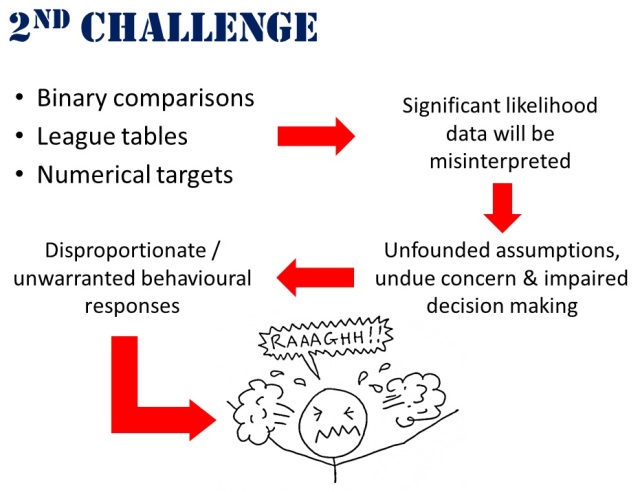
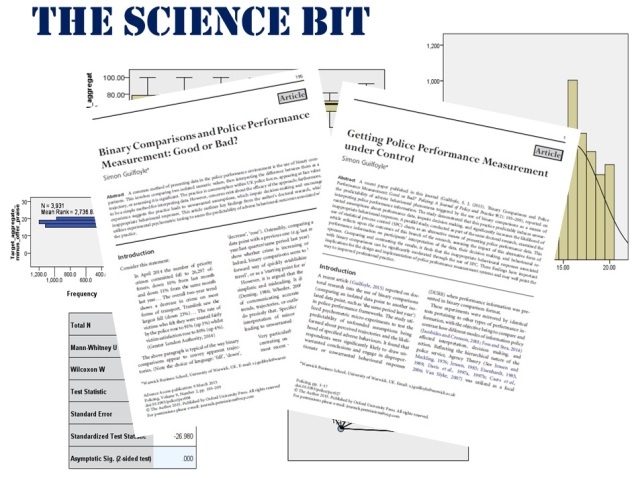
I’ve heard this one a lot. The problem is that comparison against targets or peers (usually in tabular and / or binary form) causes managers to ask the wrong questions. “Why is your team’s performance worse than the other team?” / “Why have you got more crime on your sector than at this time last year?” / “Why haven’t you hit your sales target for this quarter?” Starting out from a limited and often poorly-presented dataset, and comparing performance against a numerical target or the fluctuating variables that are inevitable amongst peer performance, increases the likelihood of incorrect assumptions and ill-informed decision making.

Oh, and don’t fool yourself that if you remove the actual numerical target but retain an ethos of comparing performance between peers (or against some random point in history) this is somehow better. This ‘league table’ approach leads to many of the same misguided assumptions and behavioural dysfunctions as targets - in essence it is akin to working towards an arbitrary moving target, rather than a static one. Avoid!

Finding the source 3

You know what? I really believe you. I suspect that most senior managers easily understand that there’s more to life than red or green arrows and don’t lose sleep if a couple of performance indicators are half a percent short of the target this month. I also believe that they take other relevant information and evidence into account when considering performance, and usually have an appreciation of the overall context.

The problem is that as you go down the levels of hierarchical organisations, the obsession with hard numerical targets intensifies. By the time you get to the front line, believe me, people DO pay A LOT of attention to the actual targets. The targets then become a focus for activity, driving behaviour and creating a culture of unhealthy internalised competition and individual blame. (See the nicely-drawn vicious circle in this blog post).

Finding the source 4

This can actually be true (sort of). Researchers Locke and Latham have shown that targets can, on the face of it, ‘improve’ performance.

The downside, however, is that this apparently improved performance cannot be sustained in the long term; furthermore, a range of evidence records examples of the dysfunctional behaviour that goes on behind the scenes to attain this ‘improved’ performance. We’ve looked at some in previous blog posts – ‘teaching to the test’, reclassifying crime figures, making arrests for ‘easy’ offences’, holding back funds until the next quarter, ‘hiding’ hospital patients in ambulances, cherry picking participants for payment-by-results schemes, excluding exam entrants deemed unlikely to succeed, ignoring important organisational responsibilities not subject of targets, prioritising what is easy ahead of what is important, outright falsification of documents, lying, cheating and so on. I hold a wealth of research papers on this and I’m happy to share.

What happens as a result of this is that your customers receive a worse service, costs go up, morale goes down, intrinsic motivation is damaged, individuals and departments turn against each other, risk is increased, reputation is adversely affected, critical interdependencies break down, waste swamps the organisation, and the system malfunctions. (All whilst hitting the targets!) I could go on.

So it goes back to the cost / benefit thing again. No matter how good you or your people are, these horrid consequences will occur when you throw targets into the mix.  Is that apparent short term ‘improvement’ really worth the overall long term damage to the system? You decide.

Finding the source 5

This is perhaps the most interesting one to me. As a Police Constable I remember my Sergeant bemoaning targets, but saying that he couldn’t do anything about them because they were ‘what the Inspector wanted’. I hear Inspectors bemoaning targets but accede on the basis that they ‘must have them because the Superintendent supports them’. Follow the trail to the top of many organisations, and some Chief Officers / Chief Executives / Managing Directors will tell you that they acknowledge targets cause harm, but feel they are still somehow expected to have them.

Finding the source picIn policing terms, it may be that the Police and Crime Commissioner insists on having targets. Does it stop there though? Some Police and Crime Commissioners will tell you that they don’t agree with targets, but their Police and Crime Panel (the body that holds them to account) expect them to have some. So where do they really originate?

Is it from the Home Office (although I’m sure I heard Theresa May insist there was only one target – ‘to reduce crime’?) Or the HMIC (the body that inspects police forces). Or the underlying political will. Or the media. Or the general public. Or simply an assumption that someone, somewhere expects targets to be present in performance frameworks.

Targets are implicit, but often no one seems to be able to trace the source. It regularly appears to be because of the person ‘one level up’. But is it? One senior officer recently told me that although he makes it known he wants officers to be free of targets and instead simply concentrate on doing the right thing, he routinely encounters frontline officers who are subject of targets which have been surreptitiously reintroduced at local levels.

Why?!

The truth might be that targets really originate in the way we think.

Kitchener - It's youSo, if you believe targets must be an inevitable feature of performance systems, my message is that they are NOT. You might find that it is YOU who is inadvertently perpetuating them, not the person above you. If so, do something about it!

Finally, if I’m wrong and you can trace the source to someone who says ‘”I’m the person at the top and it’s me who insists on targets”, then let me know who it is so I can have a word.

Note – the comments discussed in this post have been made to me many times by many different people in different organisations. If you think you recognise yourself as having made them, don’t think this post is about you – it’s not. I just ask that you stop and think about what you’ve read.

Posted in Systems thinking | Tagged , , , , , , , , , , , | 6 Comments

Panic!

There’s…

“Panic on the streets of London! Panic on the streets of Birmingham!”

So says the song of the same title by UK band The Smiths, anyway. The true story that follows (yes, I’ve caved in to popular demand and presented it as one of my terrible drawings) demonstrates how well-meaning, but ultimately poorly-executed use of performance data can lead to widespread panic and counterproductive knee-jerk reactions.

Starting at the top left, work your way through this little beauty…

Panic diagram

What happened there then?

Well, the helpful analysts (who meant well) managed to initiate a sequence of increasingly panicked events because they aggregated a bunch of data together at a high level and presented it in a format that makes it impossible to interpret meaningfully. Despite the opaque nature of what was churned out, no one questioned it, and senior managers then drew conclusions based on assumptions about stuff that wasn’t actually there.

Next, the assessment that a particular type of crime increased during one month last year (compared to the previous month – a binary comparison - Nooooo!!!) was disseminated with great urgency to divisional management teams. Faced with such apparently unequivocal evidence that something would probably go wrong again this year, panic sets in and we see more knee-jerking than a row of Can-Can dancers.

A predictable battery of tactics – written plans, resources being shifted about at the drop of a hat, more meetings etc – are unleashed, until one bright spark, quite far down the organisational food chain, decided to look at the data in context using control charts. And you know what..?

There were NO signals.

Panic over everyone!

So… points to take away from this story:

  • Good intentions are not enough.
  • Good people naturally want to do something to tackle perceived problems, but sometimes it’s best not to react.
  • Only ever use data in context to establish an evidence base for action.
  • Don’t panic!

As Deming used to like saying, “In God we trust. All others bring data”.

Oh, and the ‘bright spark’ I referred to wasn’t me by the way.

Notes (Added 16th April 2013)

Now, I am not going to make a habit of qualifying my ramblings with disclaimers that are longer than the actual posts, but just to ensure that no one gets the wrong impression about what I’m saying in this one, or why, here’s a couple of things I want people to be clear about:

1. The post is about the unintended consequences that can occur when managers draw erroneous conclusions about data. It is definitely not a pop at analysts. I know of many analysts who routinely use control charts, as well as others who would relish the opportunity to use them more often.

2 Apparently, there was also …panic on the streets of Carlisle, Dublin, Dundee, Humberside.” This is not to suggest that the story in this post necessarily emanated from London, Birmingham, Carlisle, Dublin, Dundee, or Humberside. They’re just lyrics from an 80s pop song.

Posted in Systems thinking | Tagged , , , , , , , , , | 6 Comments

Ministry of Silly Systems

Recently, I had cause to write to a Government department to ask a question. I knew my query was in good hands as soon as I received an automated reply advising me of their service level agreement for replying to correspondence within a 15 day target…

Today I received their reply (within the specified time frame). The sequence of events that followed prompted me to set about scrawling more of my childlike drawings, which I present to you below:

Ministry flow chart 1

So the outcomes of this debacle are as follows:

  • Avoidable waste.
  • Avoidable cost.
  • Unnecessary effort.
  • My query remains unresolved.
  • Aggravated customer.

But most importantly of all from the department’s perspective – (yes you’ve guessed it)…

  • Their 15 day correspondence target is met!

I’m sure their next non-reply will also meet the correspondence time target. You see, this sort of situation is a good example of what happens when real purpose (i.e. answer the question!) becomes supplanted by a de facto organisational purpose (i.e. get the customer out of the department’s hair within the specified correspondence time target by any means necessary).

Furthermore, from speaking to the nice lady who phoned me back (but who was unable to help), it would appear that their service level agreement might well have been drawn up without any understanding of the proportion of failure demand in their demand profile which keeps them so busy that it routinely takes up to 15 days to reply.

I offered some solutions to improve the customer experience and save them loads of time, effort and money. You may borrow these ideas if you like…

  1. Answer the question / solve the problem first time round if you can.
  2. Learn what is in your demand profile – don’t just assume it’s all value demand.
  3. Identify the failure demand and waste that is present then remove / prevent it. (See point 1).
  4. Use an email address that allows customers to reply directly!
  5. Get rid of that silly target.

And here’s what my alternative model might look like…

Ministry flow chart 2

Posted in Systems thinking | Tagged , , , , , , | 8 Comments

One Thing Leads To Another

Being as I know you love my artwork, I thought I’d treat you to this pictorial representation of a particularly nasty little cycle that is behind a lot of serious organisational failures.

Look at the sort of stuff that starts it off.

Look at the totally predictable consequences.

Look at how typical reactions are guaranteed to perpetuate the cycle.

failings chart

You choose a serious organisational failure and see how the diagram relates to it.

Tackling the real deep-seated issues requires a different type of management thinking. It also requires a will to address the underlying system conditions that exacerbate human error to such a degree that serious organisational failures ensue. ‘More of the same’ is not the solution. Tackle the cause, not the symptoms!

Come on someone – break the cycle!

Short post, this time. It’s all about the prize-winning pen strokes.

For more on error causation theory read this.

For the Pet Shop Boys track whose title I borrowed for this blog post, click here.

Posted in Systems thinking | Tagged , , , , , , , , , | 11 Comments